

Rigid Inclusions
Rigid inclusions reduce settlement by creating a stiffer load path through weak or compressible soils below a loaded area.
Pacific Foundation carries rigid-inclusion work from field testing through production installation, giving project teams a tested basis for treating weak ground.
How Rigid Inclusions Work
Rigid inclusions are stiff vertical elements installed through weak or compressible soil. Together with the surrounding soil and load-transfer platform, they form a composite ground system.
Load from the platform is distributed into the inclusion pattern. Each inclusion carries part of that load through weaker upper soils to more competent material, reducing total and differential settlement.
Broad loaded areas can benefit where shallow support needs improved settlement performance. Soil profile, loading, platform design, and installation access determine whether the system is practical.
When to Use Rigid Inclusions
Rigid inclusions fit projects where settlement or bearing response controls a broad loaded area. The load must be distributable through a platform into a repeatable inclusion pattern.
Heavy point loads, high lateral demands, major obstructions, tight geometry, or no workable platform can make another foundation or ground-improvement method more appropriate.
Large loaded areas
Rigid inclusions are well suited for building pads, slabs, tanks, mats, embankments, and other broad loaded areas where settlement control is the primary goal.
Weak or compressible soils
The method is used where upper soil layers are too soft, loose, organic, or compressible to meet settlement requirements without improvement.
Shallow foundation support
Rigid inclusions can help make shallow foundation or slab-supported designs feasible when untreated ground would move too much.
Repeatable installation pattern
The site needs enough room and consistency for inclusion spacing, sequencing, platform construction, and verification to be installed cleanly.
Equipment and Tooling
Rigid inclusion equipment is selected around the ground improvement system the project needs to build. Depth, diameter, installation method, soil response, working platform capacity, access, production sequence, and spoil handling all affect the rig and tooling choice.
A stable working platform is part of the method. It has to support the installation equipment while also fitting the construction sequence for the load-transfer layer above the inclusions.
 Bauer BG 24 H
The Bauer BG 24 H is a mid-size H-kinematics vertical drill rig for drilled foundation and shoring work.
View equipment Bauer BG 33 H
Heavy vertical drill rig used for CFA tooling, drilled foundation work, and production pile installation where pile size, access, and sequencing need coordinated field control.
View equipment Bauer BG 40 V
The Bauer BG 40 V is a large vertical drill rig built for deep and large-diameter foundation drilling.
View equipment Bauer BG55
The Bauer BG55 is a heavy vertical drill rig used for large-diameter and deep-drilling foundation work.
View equipmentEquipment selection starts with the installation method, depth, diameter, soil profile, working platform, and available access. Spoil generation or displacement also affects the setup.
The working platform must carry the equipment safely and consistently. Weak platform assumptions slow production and make tolerances harder to control.
Pacific confirms the rig and tooling only after reviewing the actual layout, ground profile, platform, and verification requirements.
Project Experience
These projects show how settlement criteria, site access, production layout, and platform planning come together in the field.
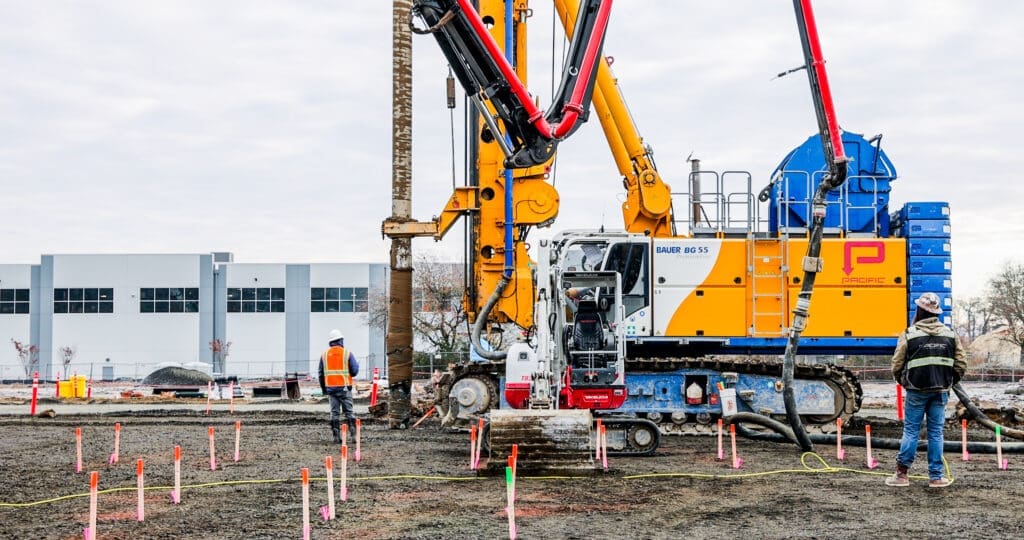 Hillsboro, OR / General Civil Aligned PDX01
Working for Holder Construction, Pacific Foundation completed the rigid-inclusion test program and installed the production rigid inclusions using two drill rigs, including a Bauer BG55.
View project Vancouver, WA / General Civil Block 1 Apartments
Pacific Foundation supported the project with rigid inclusions, jet grouting, soldier piles, and lagging.
View projectPacific Capabilities
Pacific reviews soil conditions, layout, platform capacity, access, production sequence, and testing before installation begins. The goal is a buildable pattern that matches the geotechnical and structural assumptions.
Rigid Inclusion FAQs
How are rigid inclusions different from piles?
Rigid inclusions are typically part of a ground improvement system, not isolated structural foundation elements. They work with the surrounding soil and a load-transfer platform to improve ground response below a loaded area. Piles are usually designed as structural elements that directly support specific loads.
What does the load-transfer platform do?
The load-transfer platform spreads load from the slab, footing, mat, tank, or embankment into the inclusion pattern. It helps distribute stress, reduce hard points, and make the inclusions and surrounding soil work together as a composite system.
When are rigid inclusions a good fit?
Rigid inclusions are a good fit when weak or compressible soils create settlement concerns across a loaded area and the site can support a repeatable inclusion layout. They are often considered for slabs, tanks, mats, embankments, building pads, and other broad loaded zones.
What can make rigid inclusions a poor fit?
Rigid inclusions may be a poor fit if the site has heavy isolated point loads, major obstructions, difficult access, high lateral demands, unclear settlement criteria, or no practical way to build the working platform and load-transfer platform needed for the system.
What should be sent for a rigid inclusion review?
Send the geotechnical report, foundation or loading information, settlement criteria, grading plans, slab or embankment details, proposed platform section, utility constraints, access limitations, and any testing or verification requirements.

Discuss Your Rigid Inclusion Scope
Send the geotechnical report, load information, settlement criteria, grading plans, and platform assumptions. Pacific will review whether rigid inclusions fit the site and how the work can be sequenced.